
The Hidden Cost of Bad Cabling: Why UAE Offices Keep Rebuilding Networks They Just Installed
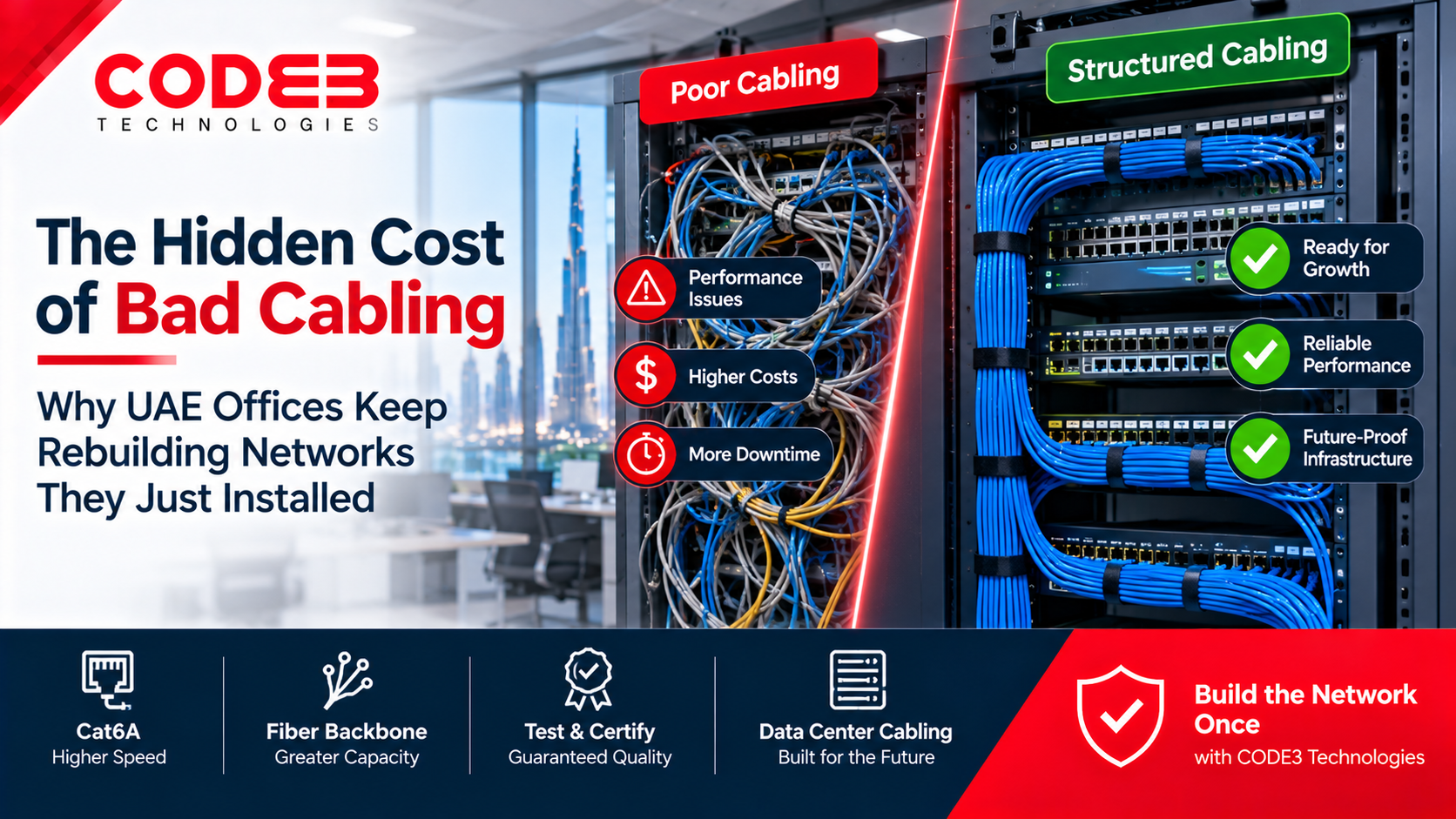
The Hidden Cost of Bad Cabling: Why UAE Offices Keep Rebuilding Networks They Just Installed
Most office networks don't fail because of the switch, the firewall, or the Wi-Fi access points. They fail because of what's behind the wall: the structured cabling installed during fit-out, usually by whoever was cheapest or fastest, with no plan for what the business would actually run over it a few years later. The hardware gets upgraded on schedule. The cabling almost never does - until it has to be ripped out and redone, at a worse time and a higher cost than doing it properly the first time.
Why It Keeps Happening
Cabling decisions get made during a fit-out or office move, when budget and attention are already split between furniture, partitions and AC. It ends up treated as a commodity line item rather than infrastructure the business will depend on for the next decade. In practice that usually means Cat5e or unverified Cat6 runs, no cable management or labeling in the rack, and no testing or certification after installation - so nobody actually knows whether the cabling performs to spec until something built on top of it stops working.
What Changed Since Most Offices Were Last Cabled
The load running over office cabling has grown well past what a basic Cat5e or Cat6 run was ever sized for. PoE-powered CCTV cameras, access control readers and Wi-Fi access points now draw power and data over the same cable a desktop PC used to use on its own. Add a 10Gbps-capable switch or a comms room that was never designed with a proper network rack in mind, and undersized or uncertified cabling becomes the bottleneck long before the hardware does.
The Cost of Getting It Wrong Twice
Re-cabling an occupied office is far more disruptive, and more expensive, than cabling it right during the original fit-out. New cable has to be pulled through walls, ceilings and risers that are no longer open - usually after-hours or in phases to avoid downtime, and around whatever CCTV, access control or AV system got added to the network in the meantime. Businesses that treat cabling as an afterthought once tend to end up paying for it twice: once for the rushed job, and again for the rebuild.
What Done Right Looks Like
Structured cabling that's actually built to last comes down to a handful of deliberate choices: Cat6A runs instead of Cat5e or unverified Cat6, so there's headroom for 10Gbps before it's actually needed; fiber on the backbone between racks and floors instead of copper stretched past its reliable distance; and every run tested and certified against spec at install, not discovered to be underperforming months later. For server rooms and comms closets specifically, that also means data center cabling done to a standard that can support whatever gets racked next, not just what's there on day one.
Build the Network Once
The UAE's push toward gigabit and multi-gigabit connectivity only pays off if what's actually behind the wall can carry it. CODE3 designs and installs structured cabling with your next few years of PoE devices, Wi-Fi upgrades and bandwidth growth already accounted for - not just what fits the floor plan today. Talk to us before your next fit-out or network upgrade.
Request a Network Assessment to see how your network and infrastructure measure up.
احصل على مقالات عملية في تقنية المعلومات
مقالات قصيرة ومفيدة عن تقنية المعلومات والأمن السيبراني للشركات في الإمارات. بدون رسائل مزعجة.