
Why UAE Businesses Are Investing in Queue Management Systems
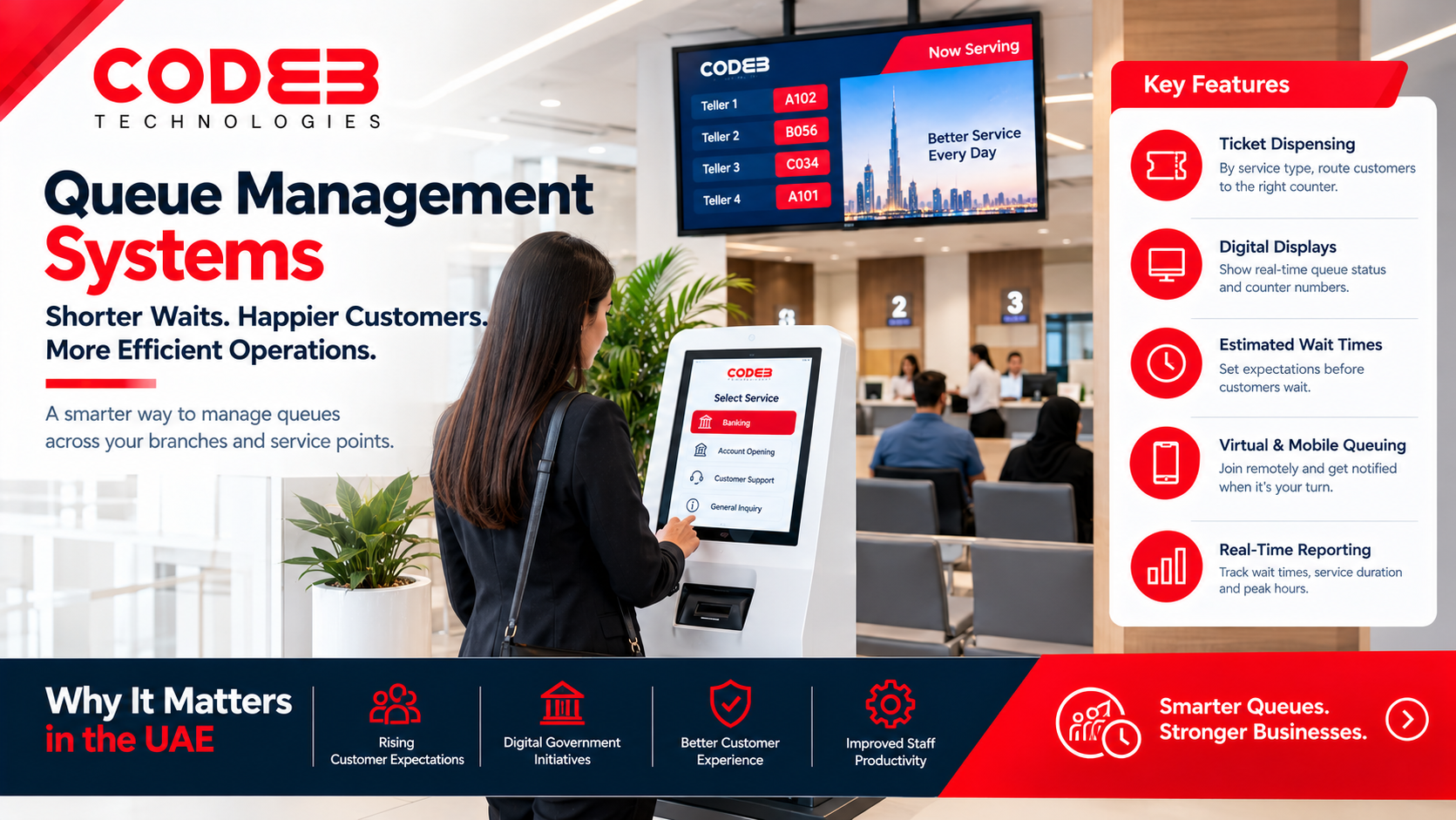
A queue that works fine at 10am and falls apart at 1pm isn't really working. Across Dubai and the wider UAE, banks, government service centers, clinics and retail counters are replacing first-come-first-served lines with structured queue management systems — not because it looks modern, but because unmanaged queues cost real money in lost customers and overwhelmed staff. Here's what's actually changed, and what to plan for if you're considering one.
What a Queue Management System Actually Does
A proper system replaces a physical line with a ticket — issued at a kiosk or touchscreen — paired with digital displays showing exactly which number is being served at which counter. Staff call the next customer with one tap, routing them automatically. Customers see an estimated wait time the moment they join, and virtual or mobile queuing lets them join remotely and get notified as their turn approaches, instead of standing in a physical line at all.
The parts that actually matter for day-to-day operations:
Ticket dispensing by service type, so customers route to the right counter from the start
"Now serving" displays that cut repeated "is it my turn?" questions to staff
Real-time wait estimates set expectations before a customer commits to waiting
Reporting on wait times, service duration and peak hours — the data needed to actually fix bottlenecks, not just guess at them
Why This Is Accelerating in the UAE Specifically
Government digital service initiatives across the UAE have pushed customer-experience expectations up sharply over the past few years, and that bar doesn't stay contained to government counters. Customers who experience a clean, predictable wait at one service point expect the same from a bank branch, a clinic reception or a telecom store — and increasingly compare businesses on exactly that. A disorganized line is now a visible gap against a rising baseline, not a neutral default anyone expects to tolerate.
Where It Actually Pays Off
Queue management earns its cost fastest in places where customers wait for a specific, variable-length service rather than browsing freely — banks, government service centers, hospitals and clinics, and telecom or retail counters handling account or support queries. The common thread: staff time per customer varies enough that a simple physical line creates unpredictable, visibly unfair waits.
What to Plan For Before Installing One
The hardware — kiosks, displays, counter software — is the easy part. The planning that actually determines whether the rollout works:
Mapping your real service types and routing rules, not just copying a generic counter structure
Deciding whether reporting needs to roll up across multiple branches from day one, or can be added later
Planning staff training alongside the technical setup — the counter interface is simple, but habits around calling and skipping customers still need to be set deliberately
Confirming whether you need integration with an existing CRM or appointment system, which changes the technical scope meaningfully
What CODE3 Actually Installs
We design and install queue management systems across Dubai and the UAE — ticketing, digital displays and real-time reporting, sized to your branch or scaled across multiple locations under one dashboard. The same team that's delivered 1,500+ projects across the region handles setup end to end, from service-structure planning through staff training. Full details are on our Queue Management Systems service page.
If customer wait times are a visible problem at your branch, get in touch and we'll recommend the right setup for your actual volume — not a generic package.
Talk to an IT Expert and get expert guidance on the right solution for your business.
احصل على مقالات عملية في تقنية المعلومات
مقالات قصيرة ومفيدة عن تقنية المعلومات والأمن السيبراني للشركات في الإمارات. بدون رسائل مزعجة.